
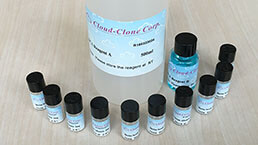
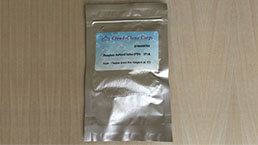
Packages (Simulation)
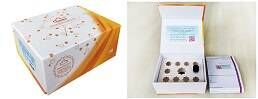
Image (II)
-
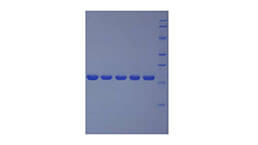
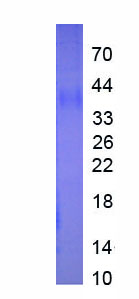 Figure. SDS-PAGE
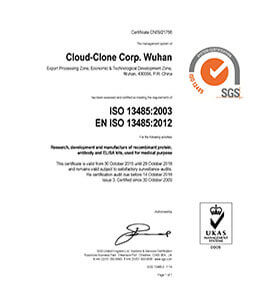
Quality Guarantee

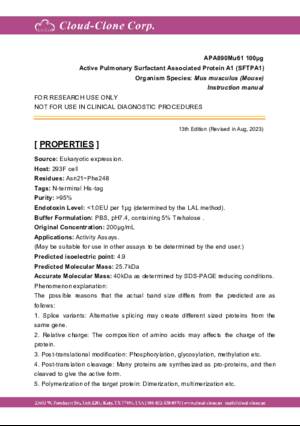
Instruction Manual
Certificate
Active Pulmonary Surfactant Associated Protein A1 (SFTPA1)
PRL; SFTPA; PSAP; PSPA; SFTP; SPA; COLEC4; PSP-A; SFTP1; SFTPA1B; SP-A1; Collectin-4; Alveolar proteinosis protein; 35 kDa pulmonary surfactant-associated protein; Surfactant Associated Protein A
- Product No.APA890Mu61
- Organism SpeciesMus musculus (Mouse) Same name, Different species.
- Buffer FormulationPBS, pH7.4, containing 5% Trehalose.
- Traits Freeze-dried powder
- Purity> 95%
- Isoelectric Point4.9
- ApplicationsCell culture; Activity Assays.
- DownloadInstruction Manual
- UOM 10µg50µg 200µg 1mg 5mg
- FOB
US$ 330
US$ 825
US$ 1650
US$ 4950
US$ 12375
For more details, please contact local distributors!
ACTIVITY TEST
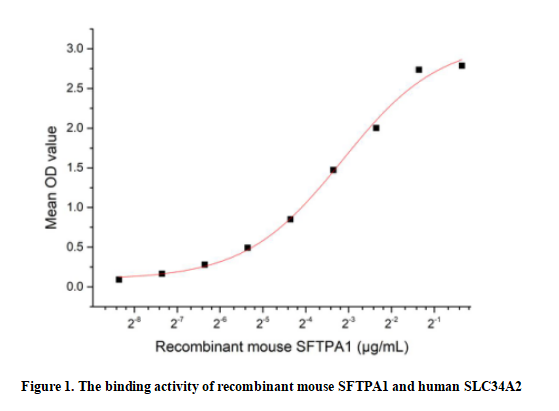
Pulmonary Surfactant Associated Protein A1 (SFTPA1) is a vital innate immune lectin abundantly expressed in mammalian lung alveolar epithelial type II cells. Encoded by the SFTPA1 gene, it serves as a core component of pulmonary surfactant, effectively lowering alveolar surface tension to stabilize lung expansion and avoid pulmonary atelectasis during respiration. Beyond mechanical respiratory protection, SFTPA1 mediates host defense by recognizing microbial surface antigens, facilitating pathogen clearance and balancing pulmonary inflammatory responses. Abnormal expression or structural defects of this protein are closely correlated with multiple chronic lung disorders and neonatal respiratory diseases, maintaining critical physiological and immunological homeostasis in the respiratory system. SFTPA1 interacts with SLC34A2 to regulate cellular phosphate uptake and pulmonary surfactant metabolic turnover.Briefly, SLC34A2 was diluted serially in PBS with 0.01% BSA (pH 7.4). Duplicate samples of 100 μL were then transferred to SFTPA1-coated microtiter wells and incubated for 1h at 37℃. Wells were washed with PBST and incubated for 1h with anti-SLC34A2 pAb, then aspirated and washed 3 times. After incubation with HRP labelled secondary antibody for 1h at 37℃, wells were aspirated and washed 5 times. With the addition of substrate solution, wells were incubated 15-25 minutes at 37℃. Finally, add 50 µL stop solution to the wells and read at 450/630nm immediately. Measured by its binding ability in a functional ELISA. When recombinant mouse SFTPA1 is lmmobilized at 2 µg/mL(100 µLwell), the concentration of SLC34A2 that produces 50% optimal bindingresponse is found to be approximately 0.113 µg/mL.
USAGE
Reconstitute in 10mM PBS (pH7.4) to a concentration of 0.1-1.0 mg/mL. Do not vortex.
STORAGE
Avoid repeated freeze/thaw cycles. Store at 2-8°C for one month. Aliquot and store at -80°C for 12 months.
STABILITY
The thermal stability is described by the loss rate. The loss rate was determined by accelerated thermal degradation test, that is, incubate the protein at 37°C for 48h, and no obvious degradation and precipitation were observed. The loss rate is less than 5% within the expiration date under appropriate storage condition.
GIVEAWAYS
INCREMENT SERVICES
-
 BCA Protein Quantification Kit
-
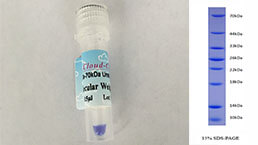 Molecular Mass Marker for Protein
-
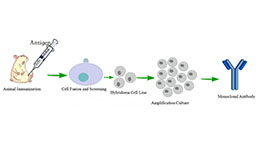 Monoclonal Antibody Customized Service
-
 Polyclonal Antibody Customized Service
-
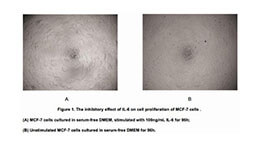 Protein Activity Test Experiment Service
-
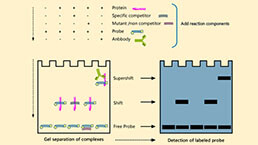 Electrophoretic Mobility Shift Assay (EMSA) Experiment Service
-
 Buffer
-
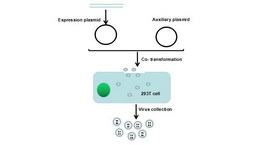 Lentivirus Packaging Experiment Service
-
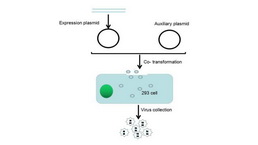 Adenovirus Packaging Experiment Service
-
 Real Time PCR Experimental Service
-
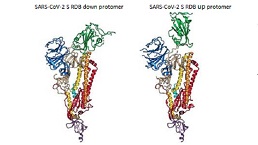 Spike RBD Protein (S-RBD)
-
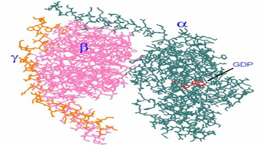 Protein G
-
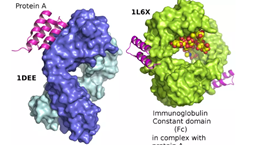 Protein A
| Magazine | Citations |
| The American Journal of Rhinology & Allergy | Surfactant protein A and D in chronic rhinosinusitis with nasal polyposis and corticosteroid response Ingenta: art00005 |
| American Journal of Rhinology & Allergy | Detection of surfactant proteins A, B, C, and D in human nasal mucosa and their regulation in chronic rhinosinusitis with polyps PubMed: 23406594 |
| Plos one | Staphylococcus aureus and Pseudomonas aeruginosa Express and Secrete Human Surfactant Proteins PubMed: PMC3551896 |
| Plos one | The Detection of Surfactant Proteins A, B, C and D in the Human Brain and Their Regulation in Cerebral Infarction, Autoimmune Conditions and Infections of the CNS PubMed: PMC3787032 |
| Nachweis und Charakterisierung des Oberfl?chenproteins PLUNC (Palate, Lung and Nasal Clone Protein) an der Augenoberfl?che und Bedeutung für das Trockene Auge Opus4:Source | |
| Mol Med Rep | Expression of surfactant protein-A in exhaled breath condensate of patients with chronic obstructive pulmonary disease PubMed: 26707652 |
| Plos One | Serum Levels of Surfactant Proteins in Patients with Combined Pulmonary Fibrosis and Emphysema (CPFE) Pubmed:27337142 |
| PLoS One | The Cerebral Surfactant System and Its Alteration in HydrocephalicConditions. pubmed:27656877 |
| Frontiers in Aging Neuroscience | Correlations of Ventricular Enlargement with Rheologically Active SurfactantProteins in Cerebrospinal Fluid. pubmed:28101052 |
| Frontiers in Aging Neuroscience | Correlations of Ventricular Enlargement with Rheologically Active Surfactant Proteins in Cerebrospinal Fluid PMC5209370 |
| American Journal of Physiology. Lung Cellular and Molecular Physiology | Chronic lung injury and impaired pulmonary function in a mouse model of acid ceramidase deficiency. pubmed:29167126 |
| Molecular biosystems | Metabolic profiling of asthma in mice and the interventional effects of SPA using liquid chromatography and Q-TOF mass spectrometry pubmed:28463380 |
| PLoS One | Evaluation of surfactant proteins A, B, C, and D in articular cartilage, synovial membrane and synovial fluid of healthy as well as patients with osteoarthritis and … Pubmed: 30235245 |
| PLOS ONE | Organic barn dust inhibits surfactant protein D production through protein kinase-c alpha dependent increase of GPR116 Pubmed: 30543664 |
| Molecular Neurobiology | Elevated levels of multifunctional surfactant proteins in cerebrospinal fluid are associated with signs of increased cerebrospinal fluid flow in cranial magnetic … Doi: 10.1007/s12035-017-0835-5 |
| Molecular Neurobiology | Rheologically Essential Surfactant Proteins of the CSF Interacting with Periventricular White Matter Changes in Hydrocephalus Patients–Implications for CSF … Doi: 10.1007/s12035-019-01648-z |
| Antioxidants (Basel) | Oxidative Stress and Inflammatory Mediators in Exhaled Breath Condensate of Patients with Pulmonary Tuberculosis. A Pilot Study with a Biomarker Perspective 34679707 |