
Packages (Simulation)
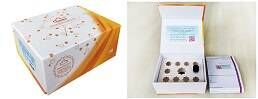
Image (II)
-
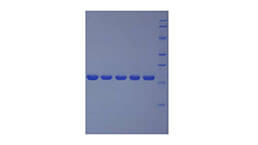
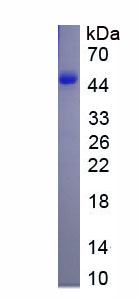 Figure. SDS-PAGE
Quality Guarantee

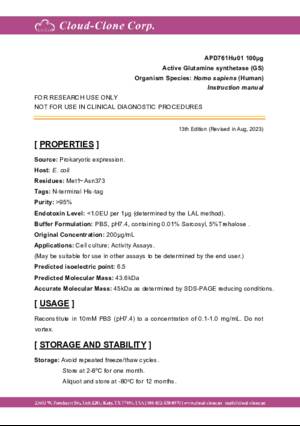
Instruction Manual
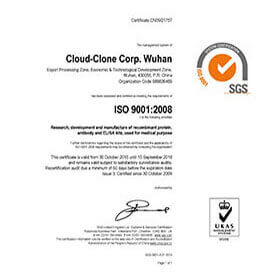
Certificate
Active Glutamine synthetase (GS)
GLNS; GLUL; Glutamate-Ammonia Ligase; Glutamate decarboxylase
- Product No.APD761Hu01
- Organism SpeciesHomo sapiens (Human) Same name, Different species.
- Buffer FormulationPBS, pH7.4, containing 0.01% SKL, 5% Trehalose.
- Traits Freeze-dried powder
- Purity> 95%
- Isoelectric Point6.5
- ApplicationsCell culture; Activity Assays.
- DownloadInstruction Manual
- UOM 10µg50µg 200µg 1mg 5mg
- FOB
US$ 220
US$ 550
US$ 1100
US$ 3300
US$ 8250
For more details, please contact local distributors!
ACTIVITY TEST
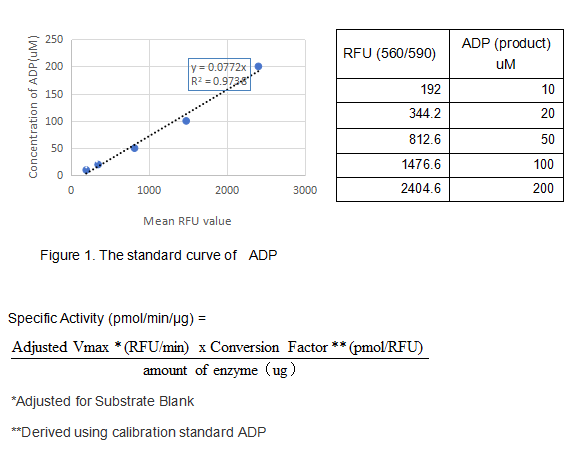
Glutamine synthetase (GS) is an evolutionarily conserved, ubiquitous enzyme. It catalyzes ATP-dependent glutamate-ammonia condensation to form glutamine, a key step in nitrogen metabolism, ammonia detoxification, and nitrogen storage. With oligomeric structures and species-specific isoforms, it’s vital for animal liver/brain function, plant nitrogen assimilation, and microbial survival in nitrogen-poor environments.GS catalyzes the reaction of L-glutamate, NH₄⁺, and ATP to produce L-glutamine, ADP, and inorganic phosphate (Pi).The activity of recombinant human GS is measured by detecting the concentration of ADP generated in the reaction system using an ADP detection kit.GS perform gradient dilution to obtain concentrations of 100ug/ml, 50ug/ml, 25ug/ml, 12.5ug/ml, 6.25ug/ml, 3.13ug/ml, 1.56ug/ml, 0ug/ml.Prepare a 200 uL enzymatic reaction system according to the following components:20uL 10mM MgCl₂,40uL 20mM L-glutamate,20uL 10mM NH₄Cl, 50uL Enzyme sample. Add ATP to the system at a final concentration of 200uM ( 4uL of 100mM stock solution), mix rapidly, immediately place in a 37°C incubator, and react precisely for 30 minutes. Detect the fluorescence intensity of each well.Take the ADP standard from the ADP detection kit and perform gradient dilution to obtain concentrations of 200uM, 100uM, 50uM, 20uM, 10uM, 0uM. Plot a standard curve with the concentration of ADP standard (mM) as the x-axis and the corresponding detection value (e.g., absorbance or fluorescence intensity) as the y-axis.Using this standard curve, we calculate the corresponding concentration and subsequently determine the specific enzyme activity. The specific activity of recombinant human GS is > 100 pmol/min/ug.
USAGE
Reconstitute in 10mM PBS (pH7.4) to a concentration of 0.1-1.0 mg/mL. Do not vortex.
STORAGE
Avoid repeated freeze/thaw cycles. Store at 2-8°C for one month. Aliquot and store at -80°C for 12 months.
STABILITY
The thermal stability is described by the loss rate. The loss rate was determined by accelerated thermal degradation test, that is, incubate the protein at 37°C for 48h, and no obvious degradation and precipitation were observed. The loss rate is less than 5% within the expiration date under appropriate storage condition.
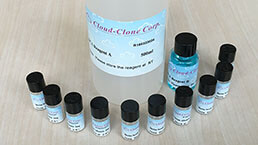
GIVEAWAYS
INCREMENT SERVICES
-
 BCA Protein Quantification Kit
-
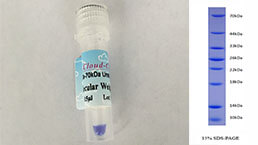 Molecular Mass Marker for Protein
-
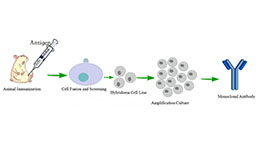 Monoclonal Antibody Customized Service
-
 Polyclonal Antibody Customized Service
-
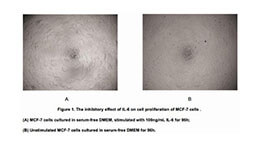 Protein Activity Test Experiment Service
-
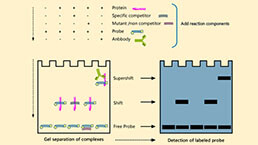 Electrophoretic Mobility Shift Assay (EMSA) Experiment Service
-
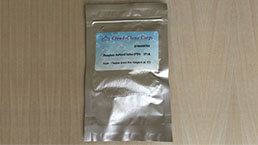 Buffer
-
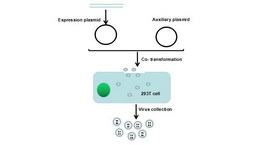 Lentivirus Packaging Experiment Service
-
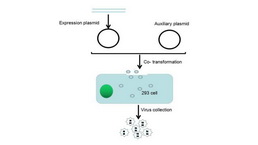 Adenovirus Packaging Experiment Service
-
 Real Time PCR Experimental Service
-
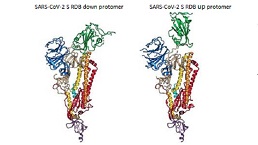 Spike RBD Protein (S-RBD)
-
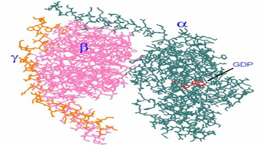 Protein G
-
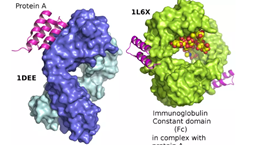 Protein A
| Magazine | Citations |
| The FASEB Journal | Cargo proteins of plasma astrocyte-derived exosomes in Alzheimer’s disease pubmed:27511944 |
| Annals of Neurology | High complement levels in astrocyte‐derived exosomes of Alzheimer disease Pubmed:29406582 |
| Journal of Neuroscience | Sex differences in the glutamate signaling pathway in juvenile rats Pubmed:28861894 |
| FASEB Journal | Deficient neurotrophic factors of CSPG4-type neural cell exosomes in Alzheimer disease Pubmed:29924942 |
| Hepatology Research | Glutamine synthetase promotes tumor invasion in hepatocellular carcinoma through mediating epithelial–mesenchymal transition Pubmed: 31652385 |
| FASEB JOURNAL | Traumatic brain injury increases plasma astrocyte‐derived exosome levels of neurotoxic complement proteins Pubmed: 31916313 |
| Translational Psychiatry | Decreased mitochondrial electron transport proteins and increased complement mediators in plasma neural-derived exosomes of early psychosis Pubmed: 33106473 |
| Drug Repurposing of Asparaginase and Vitamin C Targeting Glutamine Synthetase Improves Anticancer Effect in Metastatic Castration-resistant Prostate … |
| Catalog No. | Related products for research use of Homo sapiens (Human) Organism species | Applications (RESEARCH USE ONLY!) |
| RPD761Hu01 | Recombinant Glutamine synthetase (GS) | Positive Control; Immunogen; SDS-PAGE; WB. |
| APD761Hu01 | Active Glutamine synthetase (GS) | Cell culture; Activity Assays. |
| PAD761Hu01 | Polyclonal Antibody to Glutamine synthetase (GS) | WB; IHC |
| LAD761Hu71 | Biotin-Linked Polyclonal Antibody to Glutamine synthetase (GS) | IHC |
| LAD761Hu81 | FITC-Linked Polyclonal Antibody to Glutamine synthetase (GS) | WB; IHC; ICC; IF. |
| MAD761Hu21 | Monoclonal Antibody to Glutamine synthetase (GS) | WB; IHC; ICC; IP. |
| SED761Hu | ELISA Kit for Glutamine synthetase (GS) | Enzyme-linked immunosorbent assay for Antigen Detection. |
| LMD761Hu | Multiplex Assay Kit for Glutamine synthetase (GS) ,etc. by FLIA (Flow Luminescence Immunoassay) | FLIA Kit for Antigen Detection. |
| CMD761Hu | Multiplex Assay Kit for Glutamine synthetase (GS) ,etc. by CBA (Cytometric Bead Array) | FLIA Kit for Antigen Detection. |