
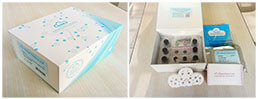
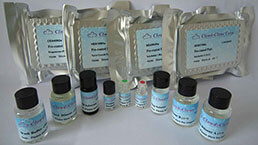
Packages (Simulation)
Quality Guarantee

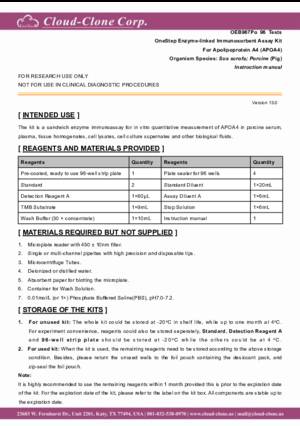
Instruction Manual
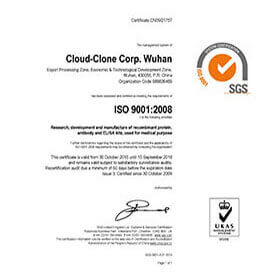
Certificate

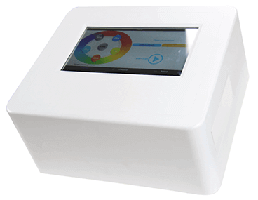
Maybe you can also pay attention to our smart microplate reader
OneStep ELISA Kit for Apolipoprotein A4 (APOA4)
ApoA-IV; ApoAIV; Apo-A4
- Product No.OEB967Po
- Organism SpeciesSus scrofa; Porcine (Pig) Same name, Different species.
- Sample Typeserum, plasma, tissue homogenates, cell lysates, cell culture supernates and other biological fluids
- Test MethodDouble-antibody Sandwich
- Assay Length1h10min
- Detection Range125-8,000ng/mL
- SensitivityThe minimum detectable dose of this kit is typically less than 51ng/mL.
- DownloadInstruction Manual
- UOM 48T96T
- FOB
US$
US$
For more details, please contact local distributors!
Specificity
This assay has high sensitivity and excellent specificity for detection of Apolipoprotein A4 (APOA4).
No significant cross-reactivity or interference between Apolipoprotein A4 (APOA4) and analogues was observed.
Recovery
Matrices listed below were spiked with certain level of recombinant Apolipoprotein A4 (APOA4) and the recovery rates were calculated by comparing the measured value to the expected amount of Apolipoprotein A4 (APOA4) in samples.
| Matrix | Recovery range (%) | Average(%) |
| serum(n=5) | 87-98 | 95 |
| EDTA plasma(n=5) | 84-101 | 88 |
| heparin plasma(n=5) | 92-99 | 95 |
Precision
Intra-assay Precision (Precision within an assay): 3 samples with low, middle and high level Apolipoprotein A4 (APOA4) were tested 20 times on one plate, respectively.
Inter-assay Precision (Precision between assays): 3 samples with low, middle and high level Apolipoprotein A4 (APOA4) were tested on 3 different plates, 8 replicates in each plate.
CV(%) = SD/meanX100
Intra-Assay: CV<10%
Inter-Assay: CV<12%
Linearity
The linearity of the kit was assayed by testing samples spiked with appropriate concentration of Apolipoprotein A4 (APOA4) and their serial dilutions. The results were demonstrated by the percentage of calculated concentration to the expected.
| Sample | 1:2 | 1:4 | 1:8 | 1:16 |
| serum(n=5) | 82-99% | 82-103% | 99-105% | 78-92% |
| EDTA plasma(n=5) | 95-102% | 87-97% | 95-105% | 96-105% |
| heparin plasma(n=5) | 90-97% | 87-101% | 81-89% | 82-91% |
Stability
The stability of kit is determined by the loss rate of activity. The loss rate of this kit is less than 5% within the expiration date under appropriate storage condition.
To minimize extra influence on the performance, operation procedures and lab conditions, especially room temperature, air humidity, incubator temperature should be strictly controlled. It is also strongly suggested that the whole assay is performed by the same operator from the beginning to the end.
Reagents and materials provided
| Reagents | Quantity | Reagents | Quantity |
Assay procedure summary
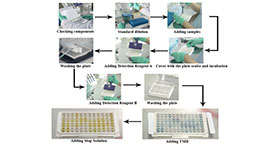
1. Prepare all reagents, samples and standards;
2. Add 50µL standard or sample to each well, then add 50µL prepared Detection Reagent A to each well. Incubate 1 hour at 37°C;
3. Aspirate and wash 3 times;
4. Add 90µL Substrate Solution. Incubate 10-20 minutes at 37°C;
5. Add 50µL Stop Solution. Read at 450nm immediately.
GIVEAWAYS
INCREMENT SERVICES
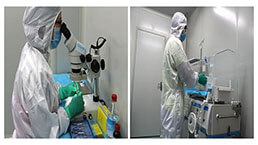
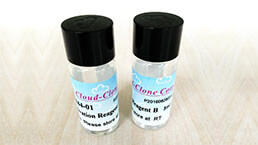
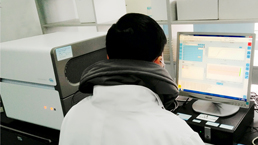

| Magazine | Citations |
| Biochimica et Biophysica Acta | Hepatic lipase- and endothelial lipase-deficiency in mice promotes macrophage-to-feces RCT and HDL antioxidant properties PubMed: 23328279 |
| Exp Ther Med. | Differential plasma proteome analysis in patients with high?altitude pulmonary edema at the acute and recovery phases Pubmed:24940404 |
| EuPA Open Proteomics | Human maternal plasma proteomic changes with parturition Sciencedirect:S2212968514000506 |
| BJOG | Development of concise audit standards for unplanned return to theate following gynaecological surgery at Gloucestershire Royal Hospital Doi: 10.1111 |
| Diagnostics | Systemic Alterations of Immune Response-Related Proteins during Glaucoma Development in the Murine Model DBA/2J Pubmed: 32585848 |
| VETERINARY PATHOLOGY | Pathology and Proteomics-Based Diagnosis of Localized Light-Chain Amyloidosis in Dogs and Cats Pubmed: 32880234 |
| Cancer Cell Int | Discovery and validation of FBLN1 and ANT3 as potential biomarkers for early detection of cervical cancer 33602229 |